
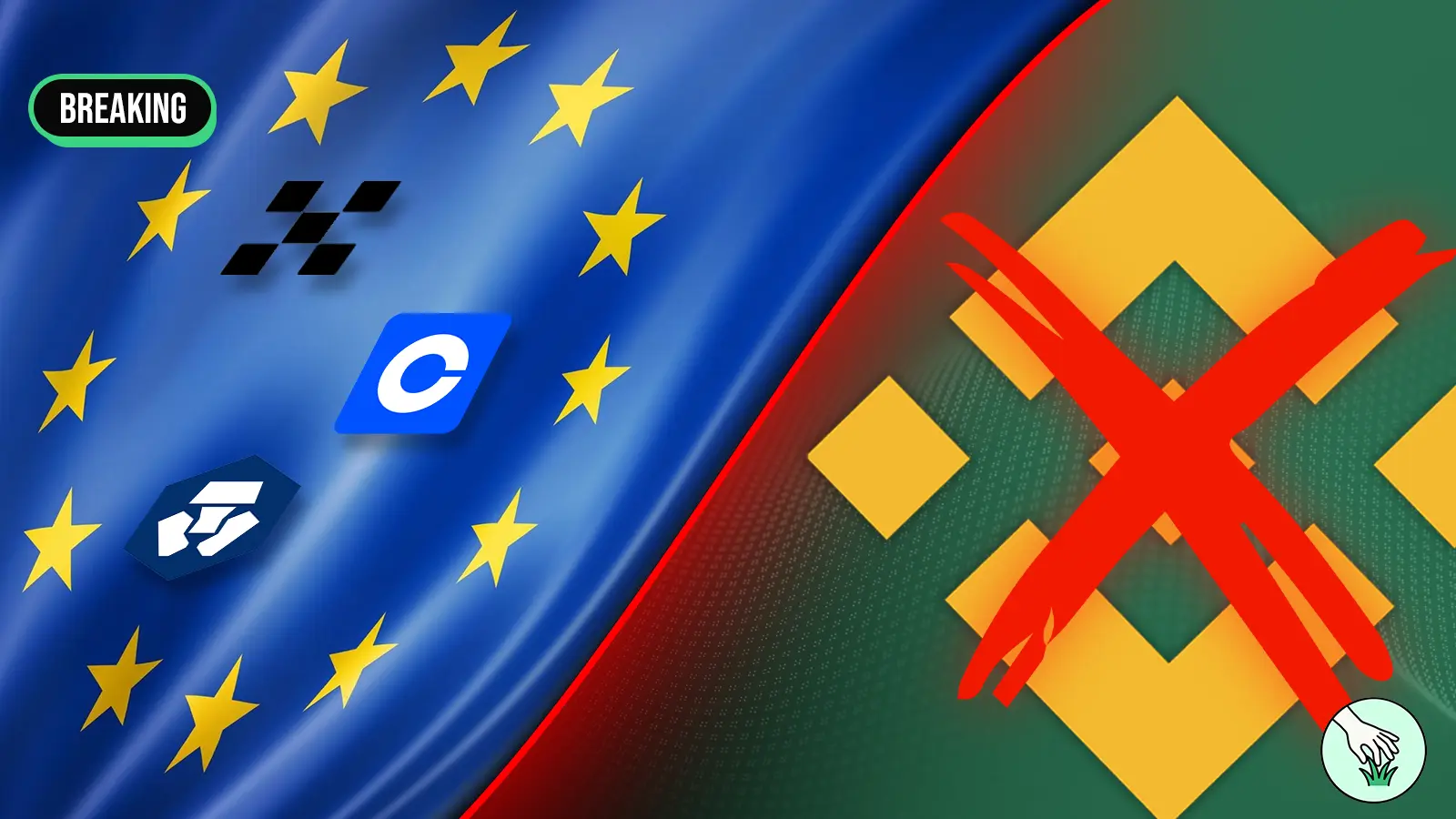
Binance got locked out of the EU on July 1. Its licensed rivals didn’t even wait for the body to cool, they’re paying cash bounties for its users. And the on-chain data says the “regulation wins” story is only half true.
There’s a specific kind of silence that follows the biggest player in a market getting escorted off the pitch. In Europe this week, it lasted about five minutes.
On July 1, MiCA, the EU’s crypto rulebook, hit its hard enforcement date. The deal is simple: no authorisation from at least one member state, no EU customers. Get licensed in one country and it “passports” across the whole bloc. Binance, the biggest exchange on earth, didn’t have one. It pulled its application in Greece on June 24, a move that came, per reporting at the time, days before the Greek regulator was expected to reject it anyway. Then it told users it could no longer accept new EU registrations and would be restricting services. Its main licence now sits in the UAE.
The scale of the cull is worth sitting with. Of the roughly 3,000 crypto firms that had been operating across Europe, only around 210 secured full MiCA authorisation by the deadline. That’s a clearance rate in the single digits. OKX’s European arm reckons around 80% of active regional exchanges will be forced to shut. Coinbase, Kraken, OKX and Crypto.com all made the cut. The biggest name in the industry did not.
Which is where the bonuses come in.
The bounty board
Within days of Binance’s announcement, its licensed rivals launched what amounts to an open-market bid for its customers. Brian Armstrong personally pitched Coinbase’s offer on X: a 5% transfer bonus for users in Germany, France, Italy and other major markets who move their funds over before July 13.
Nothing says “we’re the responsible ones” like a cash bounty on your rival’s users.
OKX went bigger. Founder Star Xu announced one of the exchange’s largest-ever welcome campaigns, with deposit matching of up to 8% for eligible EEA users. Kraken, not to be left out, is reportedly running million-euro prize draws.
8% over 52 weeks. The leash is complimentary.
Read OKX’s fine print, though, and you’ll find the industry’s oldest trick wearing a compliance badge: the 8% is capped at €20,000 and paid out in USDC over 52 weeks. That’s not a bonus, that’s a leash. Stay a full year or leave the money on the table. Old habits die licensed.
Xu, for his part, hasn’t limited himself to marketing. The OKX founder has spent the past week publicly needling CZ over Binance’s compliance record, and separately questioned the accuracy of parts of his recent memoir, a claim CZ’s book tour presumably didn’t have on the bingo card. The two go back a decade to CZ’s stint at OKCoin. It shows.
What the chain says
The raid appears to be working. Data cited from DeFiLlama on July 2 put OKX’s inflows at $1.199 billion as exchanges pulled services from Europe, and OKX Europe’s general manager Erald Ghoos reported record new-customer sign-ups into the deadline. Binance, meanwhile, logged over $400 million in net weekly outflows in the final week of June, with the single biggest daily spike, $1.96 billion out, landing the day it announced the Greek withdrawal.
The licensed exchange finished third. Read that again.
One honest caveat before anyone declares a bank run: Binance routinely moves billions in and out daily, and the flow data doesn’t say where withdrawals originate geographically. Outflows during a deadline week are suggestive, not proof of an exodus.
But here’s the detail the “regulation triumphant” write-ups keep burying. In DeFiLlama’s net-inflow rankings for the final pre-deadline week, OKX, the loudest MiCA-licensed suitor, finished third. Ahead of it: Bitget, with $710 million, and Bitfinex, with $400 million. Neither appears on ESMA’s interim MiCA register. To be clear, that’s an observation about where money flowed, not an allegation against either exchange. Global platforms take deposits from everywhere, and the data doesn’t isolate European users. Still, the shape of it is hard to miss: a meaningful chunk of capital leaving an unlicensed exchange appears to have sailed straight past the licensed ones and landed somewhere else entirely. You can write a 400-page rulebook. You cannot regulate the degen out of the degen.
The bit everyone skips
Binance’s position, for the record: it says user assets remain safe and accessible, its European ambitions are unchanged, and it expects to secure a MiCA licence through another member state “in the coming months.” This is a lockout, not a liquidation. If the licence lands, some of this week’s poaching may prove temporary.
One more thing worth knowing if you’re among the displaced: ESMA has warned that MiCA protections apply only to the specific licensed European entity serving you, not to every company sharing the brand on the app icon. Check the register, not the logo.
Europe just ran the biggest forced migration in crypto’s history. The licensed exchanges are paying for the privilege of catching it. The unlicensed ones, apparently, are catching plenty anyway.
Flow data reflects reporting at the time of writing and does not indicate the geographic origin of funds. Nothing here is financial advice. And no, an 8% bonus paid over 52 weeks is not free money.