
A once-top-10 exchange announced this week it has ceased operations, with user funds in limbo and no promise anyone gets made whole. The goodbye letter leads with a respectable regulatory excuse. The real confession is buried near the bottom, and the on-chain warning signs were public two weeks before the announcement.
On July 6, AscendEX told its users it had ceased operations, effective July 1. If the name doesn’t ring a bell, the older one might: this is BitMax, founded in 2018, once a top-10 exchange by volume, backed by a $50 million Series B led by Polychain. It survived a $78 million hack linked to North Korea’s Lazarus Group in 2021. It did not survive 2026.
The shutdown notice opens with the tidy explanation. The EU’s MiCA regime hit its hard deadline on July 1, AscendEX didn’t have authorization, and so, the framing goes, the rulebook claimed another casualty. It’s a believable story. We covered the great MiCA cull last week, when only around 210 of roughly 3,000 crypto firms operating in Europe made the cut. One more name on the list barely registers.
Then you read to the bottom of the letter.
The buried line
Near the end of the notice, past the regulatory framing, sits this sentence: “We relied on an agreed strategic transaction that was to provide liquidity to grow the platform, and the counterparty did not perform.”
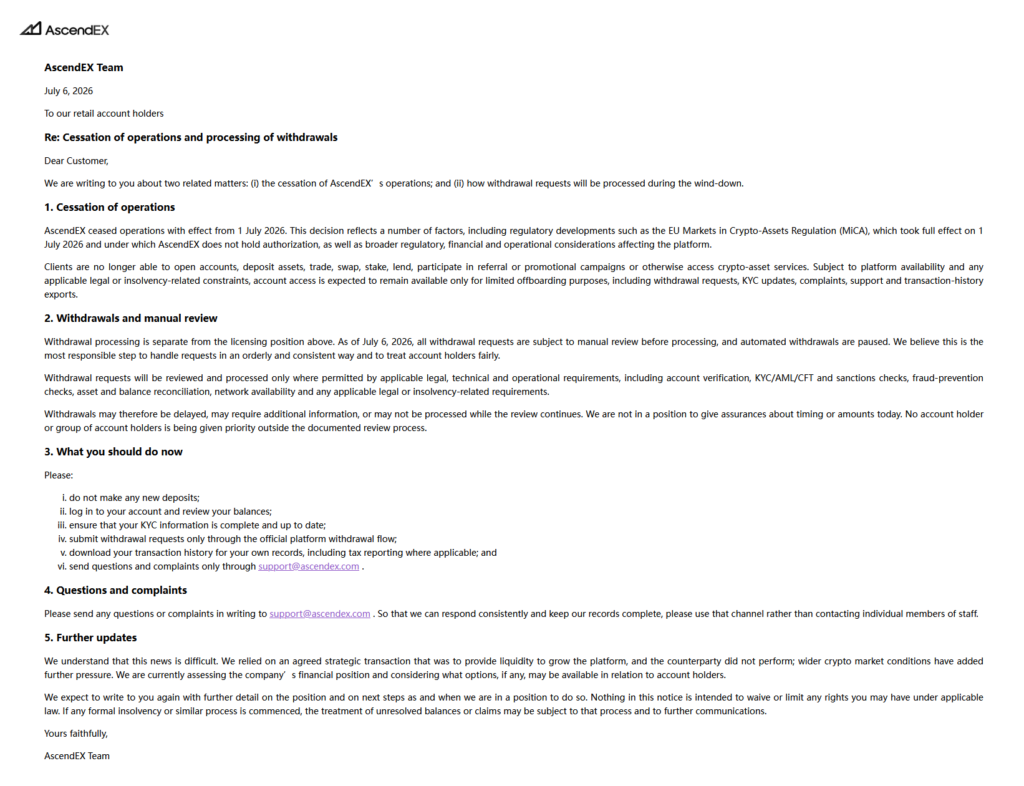
The excuse is at the top. The confession is at the bottom.
Translate it from corporate: we were counting on a deal to bring in money, the money never arrived, and there wasn’t enough left without it. That is not a regulatory story. That is a liquidity story wearing a regulatory story’s clothes. MiCA doesn’t pause your withdrawals. An empty till does.
And the terms of the shutdown read exactly like the second story. Automated withdrawals are paused. Every request goes through manual review, including what the notice calls “insolvency-related requirements.” AscendEX says it cannot guarantee users will recover their full balances, cannot give a timeline, and warns that if formal insolvency proceedings begin, customer claims may be handled inside them. The exchange’s 24-hour trading volume currently reads zero.
None of that is what winding down for a licensing problem looks like. All of it is what running out of money looks like.
The warning was free, public, and two weeks early
Here’s the part that should sting, because it was preventable at the individual level. On June 26, eleven days before the announcement, the on-chain investigator ZachXBT publicly flagged AscendEX. His findings, via Arkham and TRM data: user withdrawals stuck for days or weeks, and hot wallets that appeared nearly empty of ETH, USDT, USDC and SOL. He urged affected users to file reports with law enforcement.
Posted days before the shutdown notice. In public. For free.
To be precise about what’s proven and what isn’t: those are ZachXBT’s findings, and he included his own caveat, which we’ll repeat, that exchange reserves can sit in cold wallets or unlabeled addresses, and AscendEX has never confirmed a shortage. He has also alleged that the exchange continued accepting deposits while withdrawals sat unprocessed, and relayed one large user’s account of getting no response from the exchange’s leadership. Those are his allegations, made from on-chain observation and user reports, not established facts. AscendEX, for its part, has not addressed them.
But note the timeline, because it’s the whole story. The wallets looked thin in late June. The MiCA deadline was July 1. The shutdown notice came July 6 and pointed at the deadline. Whatever finally killed AscendEX, the symptoms were visible before the thing it blamed had even happened. MiCA wasn’t the murder weapon. MiCA was the tombstone. The wallets were already looking empty.
The lesson, minus the lecture
Somewhere between the June 26 thread and the July 6 notice, there was a window. The users who watched the on-chain investigators had eleven days of warning. The users who watched the exchange’s own status page found out when the door was already locked, and are now reading the phrase “insolvency-related requirements” in connection with their own money.
That’s the pattern worth banking, because it repeats every cycle: the exchange’s communications are the last place the truth arrives. The chain leaks it first, the investigators read it second, the goodbye letter admits it last, in a subordinate clause, at the bottom, after the respectable excuse. FTX users learned it. Now AscendEX users are learning it.
The boring old advice survives another funeral: an exchange balance is an IOU, the chain doesn’t lie, and coins you actually need should live somewhere a counterparty “failing to perform” can’t touch them.
AscendEX operated for eight years, survived Lazarus, and died owing its users an explanation it only half gave. The full one, as usual, was on-chain the whole time.
AscendEX’s shutdown terms and quoted statements are from its own July 6 notice. The observations about hot wallet balances, continued deposits, and unanswered user contact are allegations by investigator ZachXBT based on on-chain data and user reports; he has himself noted that reserves may sit in unlabeled or cold wallets, and AscendEX has not confirmed any shortfall. No insolvency has been formally declared at the time of writing and no wrongdoing by any individual has been established. Nothing here is financial advice, except possibly the bit about IOUs.