

On June 29, Strategy quietly filed for the right to sell Bitcoin. We covered it while crypto twitter argued about whether it mattered. It is July 6. They’ve sold 3,588 BTC for $216 million, at prices below their own average cost, and the filing says the $1.25 billion program hasn’t even been touched yet. Also buried in there: they’re now underwater on the entire stack.
A week ago we wrote that Strategy had given itself the green light to sell Bitcoin and that almost nobody was reading the actual filing [LINK: original Saylor article]. The takes at the time split into two camps: “SAYLOR IS DUMPING,” which was wrong, and “it’s just boilerplate optionality, they’ll never use it,” which has now aged exactly seven days.
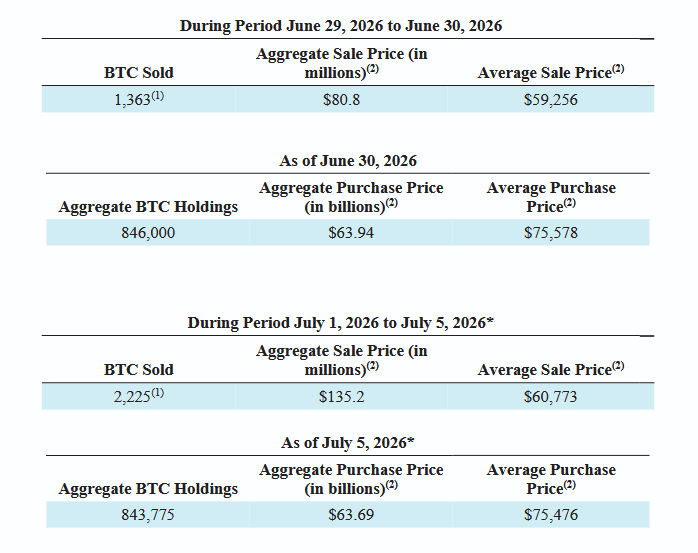
Today, in a fresh 8-K, Strategy disclosed it sold 3,588 BTC between June 29 and July 5 to fund the dividends on its preferred stock. The company now holds 843,775 Bitcoin and a $2.55 billion cash reserve.
And if you want confirmation this is real and not another Arkham-alert misread, do the arithmetic. On June 29 the company reported holding 847,363 BTC. Subtract 3,588. You get 843,775, to the coin. It happened in two tranches: 1,363 BTC sold for $80.8 million at an average of $59,256, then another 2,225 for $135.2 million at an average of $60,773. Total: $216 million, net of fees.
Hold those sale prices in your head, because they’re about to matter.
The week Bitcoin paid the bills
Why sell? The filing says it plainly: proceeds went to fund distributions on the preferred stock and to top the USD reserve back up after paying them.
Here’s the number that explains everything. By the company’s own Q1 disclosure, STRC alone, its flagship “Stretch” preferred, has scaled to $8.5 billion, which Strategy proudly calls the largest preferred stock by market cap in the world. It yields around 12%. Run the maths and you get a dividend bill in the region of a billion dollars a year, on that one instrument, before counting the rest of the preferred family. That mouth has to be fed in cash, every month, regardless of what Bitcoin is doing.
For six years the flywheel ran one direction. Sell stock and preferreds, buy Bitcoin, watch number go up, sell more paper against the bigger number. Last week the cash came from $1.15 billion of stock sales. This week, per the same 8-K, the at-the-market program sold precisely zero shares. The stock machine went quiet, the dividends still came due, and for the first time, the Bitcoin itself wrote the cheque.
The part nobody will read down to
Two more things are sitting in this filing, and they’re arguably bigger than the sale.
First, the program status. The June 29 authorization allows up to $1.25 billion of Bitcoin sales to fund the reserve. Per the new filing, after this week’s $216 million of selling, “the full amount of this capacity remains available.” Read that again. They sold a quarter of a billion dollars of Bitcoin and are treating the big authorization as untouched. However you account for it, the practical takeaway is the same: the selling has started, and the gun is still fully loaded on top of it.
Second, the quarter. Strategy recorded an $8.32 billion loss on its digital assets for Q2. And as of June 30, the cost basis of its Bitcoin exceeds the fair value of its holdings. In plain English: the largest corporate Bitcoin holder on earth, average purchase price $75,476, is underwater on the entire stack. Which means this week’s sales at $59,256 and $60,773 were made at a realized loss. The company that spent six years buying every dip just sold one.
The honest counterweight
Before anyone prints the obituary, the proportions. 3,588 BTC is about 0.42% of Strategy’s stack. They still hold more Bitcoin than any company on earth by a country mile, the reserve sits at $2.55 billion, and their framing will be that this is precisely what the mechanism was built for: a managed reserve, not a liquidation. They’ve technically sold once before, a small tax-motivated sale back in late 2022, and the sky stayed up.
All true. And also not the story.
The story is the direction of the machine. Michael Saylor spent years telling the world he would never sell, that the exit strategy was “there is no exit strategy.” The company’s entire identity, and a decent chunk of Bitcoin’s institutional bull case, was built on the premise that this stack only ever grows. That premise now has an asterisk with an SEC filing number on it. Not because they panicked, but because the yield machine they built to buy the Bitcoin has to be paid, and this week Bitcoin was the only thing paying it.
The pattern you should actually notice
Zoom out and it’s been quite a fortnight for the institutions. The spot ETFs just posted the worst month in their history, $4.5 billion out, with the suits redeeming into the exact hands they were supposed to replace [LINK: BlackRock ETF article]. And now the most famous corporate holder on earth has crossed the one line everyone assumed was structural, selling below its own cost basis to service a 12% dividend. Meanwhile, per the on-chain data, the long-term holders keep accumulating.
The trenches were told the grown-ups were coming to make Bitcoin safe and steady. Eighteen months later the grown-ups are the sellers, and the degens are the bid. The never-sell era didn’t end with a crash. It ended with a dividend payment.
843,775 left, and $1.25 billion of authorized selling still on the table. We’ll be reading the next filing so you don’t have to.
Figures are from Strategy’s Form 8-K filings of June 29 and July 6, 2026, including $216.0 million in aggregate sale proceeds net of fees, the company’s stated USD reserve of $2.55 billion, and its Q2 digital asset loss of $8.32 billion. Q2 figures are management-prepared and unaudited per the filing. Nothing here is financial advice, and no, we don’t know if he’s done selling. Neither does anyone quote-tweeting about it.